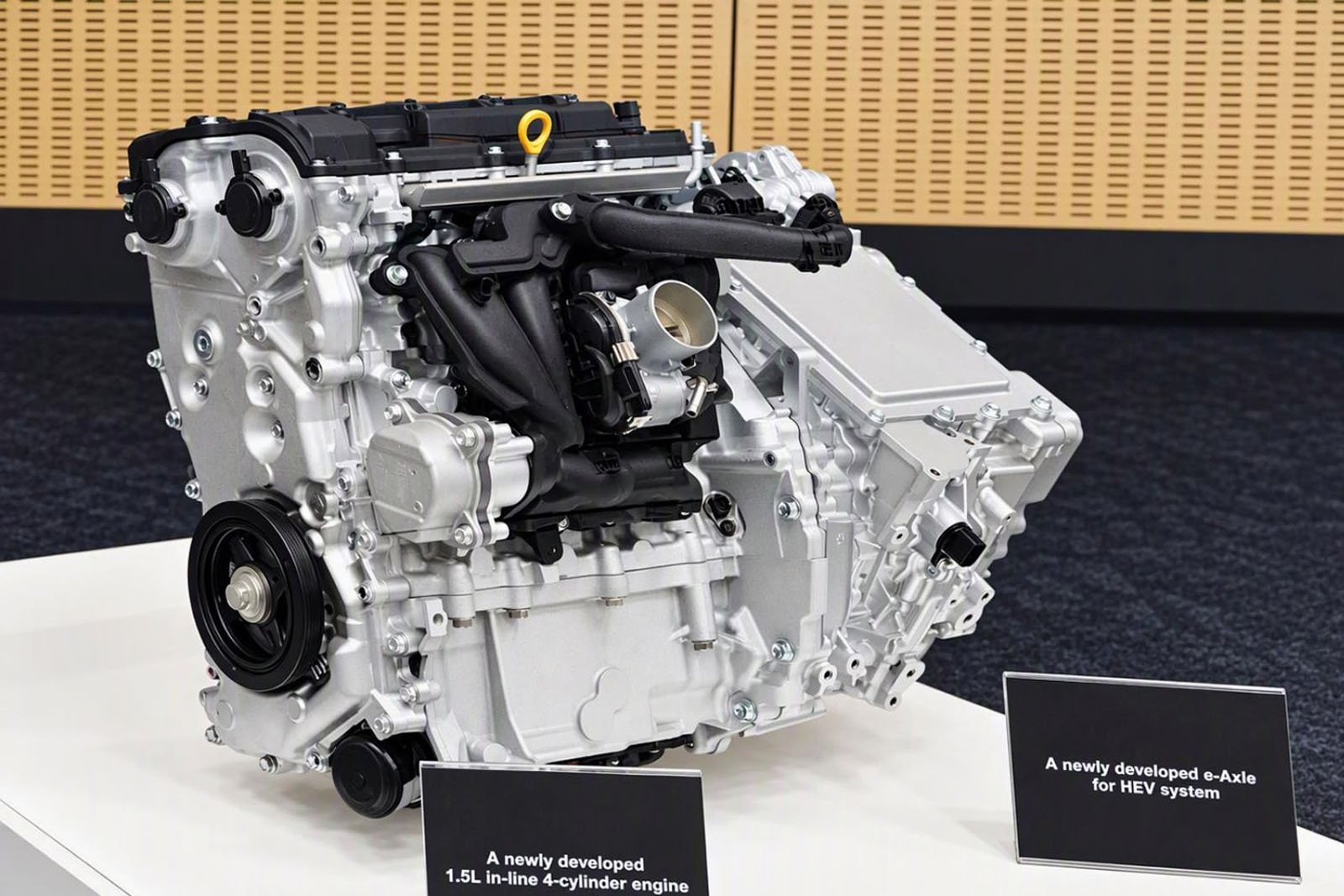
Toyota has announced an entirely new petrol engine that will be produced in naturally aspirated and turbocharged forms, intended for use in future hybrid cars rather than standalone combustion models. The automaker says the new hybrid package, which integrates lighter and smaller power control units and inverters plus a new e-axle, is 15% more efficient than its previous hybrid powertrains.
Key Takeaways
- Toyota has announced a new petrol engine for future hybrid vehicles, offered in naturally aspirated and turbocharged forms.
- The engine is paired with lighter and smaller power control units and inverters, along with a new e-axle.
- Toyota claims the new hybrid powertrain is 15% more efficient than its previous systems.
- The efficiency gain is attributed to less internal friction, better thermal management and reduced electrical losses.
- The announcement shows Toyota continuing to invest in combustion engines as part of its hybrid strategy amid the shift toward battery-electric vehicles.
Context & Details
Toyota’s decision to develop a fresh petrol engine comes as much of the industry focuses on battery-electric vehicles. The new unit is not presented as a replacement for electrification, but as part of a hybrid system that combines a combustion engine with updated electrical hardware.
The engine will be built in both naturally aspirated and turbocharged forms. Toyota says it is intended for future hybrid cars, where it will work with lighter and smaller power control units and inverters. A new e-axle is also part of the package.
Toyota’s 15% efficiency claim applies to the hybrid powertrain compared with its previous hybrid systems. The company credits the improvement to reduced internal friction, better thermal management and lower electrical losses. Those areas are central to hybrid efficiency because they affect how effectively the engine and electric components work together.
The announcement did not detail engine displacement, power output, specific model applications or launch timing. As a result, the new engine’s role in Toyota’s lineup remains focused on future hybrid applications rather than a confirmed production vehicle.
The move underscores that combustion engines still have a role in Toyota’s near-term product planning, particularly when paired with electrified components. Rather than framing the engine as a step away from EVs, Toyota presents it as a way to improve the efficiency of hybrid vehicles that are expected to remain part of the market.
What to Watch Next
The next questions are which Toyota hybrid models will receive the new engine and how quickly the company moves from announcement to production. It will also be important to see whether the 15% efficiency improvement is demonstrated in real-world driving and independent testing.
For now, Toyota has confirmed the technical direction: a new petrol engine, updated hybrid hardware and a stated efficiency gain. Further details on specifications, model rollout and production plans are still to come.