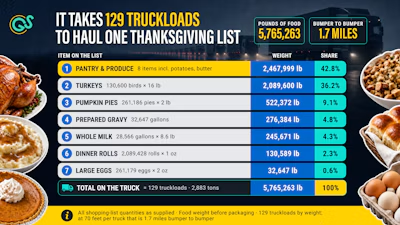
According to a new study by GamblingSites.com, feeding every National Football League fan a traditional Thanksgiving dinner would require a convoy of 129 tractor‑trailers, spanning roughly 1.7 miles bumper to bumper. The analysis calculated the ingredients needed to serve a nine‑dish holiday meal to all 2,089,428 stadium seats across the league’s 30 venues, resulting in a shopping list that weighs approximately 5.77 million pounds before packaging.
The bulk of the menu consists of 130,600 whole turkeys, each weighing an average of 16 pounds, alongside nearly 1.7 million pounds of potatoes and sweet potatoes. The study also calls for 261,186 pumpkin pies and 2,089,428 dinner rolls. MetLife Stadium in East Rutherford, New Jersey, tops the list, needing 5,157 turkeys and 41,250 pounds of potatoes; Lambeau Field in Green Bay, Wisconsin, follows with 5,091 turkeys and 40,721 pounds of potatoes, while AT&T Stadium in Arlington, Texas, rounds out the top three.
Reported Details
The research assigned one complete Thanksgiving meal per stadium seat and then divided the aggregate food weight by an assumed 45,000‑pound cargo load per dry‑van trailer to arrive at the 129‑truck total. The calculation assumes each tractor‑trailer spans approximately 70 feet and does not account for refrigerated capacity, cargo volume, or other real‑world delivery constraints. The estimates reflect food weight before packaging.
Key Highlights
- 129 tractor‑trailers required to deliver 5.77 million pounds of food
- 130,600 turkeys, each 16 pounds, make up the largest single item
- MetLife Stadium demands 5,157 turkeys and 41,250 pounds of potatoes
- Top 10 stadiums include MetLife, Lambeau, AT&T, Arrowhead, Empower, Mile High, Bank of America, Caesars, NRG, M&T Bank, and Mercedes‑Benz
- Total of 261,186 pumpkin pies and 2,089,428 dinner rolls across the league
- Assumed cargo load per trailer: 45,000 pounds; trailer length: 70 feet
Status & Next Steps
The study remains a theoretical calculation; no actual delivery operations have been announced by NFL teams or vendors. The findings highlight the logistical scale of a league‑wide Thanksgiving meal and could inform future planning for large‑scale food distribution in sporting events. As the NFL approaches its Thanksgiving season, teams and catering partners may review the data to optimize supply chains, refrigeration needs, and route planning. No immediate action has been taken, and further research may refine the estimates by incorporating real‑world constraints such as cargo volume and refrigerated capacity.